HomeIndustries › Borders, Ports & Aviation

Body Cameras for Borders, Ports and Aviation

Body-worn cameras, vehicle recording, docking and evidence management for customs inspection, container terminals and airside operations. In most of this sector the requirement comes from the site access rules and the operator’s own evidence policy rather than from a camera regulation.

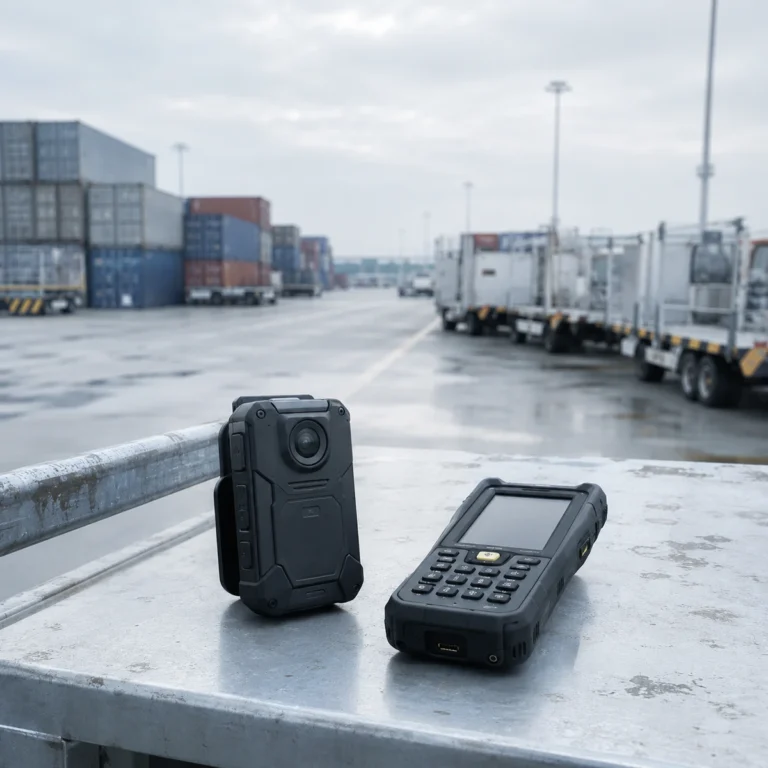
Body camera and rugged handheld radio at a UAE container port

What a border, a terminal and an apron have in common

Six problems decide whether a camera programme works across these three environments. Three are answered by the hardware and three by what happens to the footage after the shift ends.

01

The inspection that gets disputed

A bag is opened at the counter, or a container is stripped in the examination bay. The passenger or the trader disagrees with how it was done. With no recording, the file holds one account of the search, written by the officer who carried it out.

02

A twelve-hour shift in a Gulf summer

An apron in July and a container yard in August both run well past the point where a consumer device gives up. Published operating ceilings across the range we supply run from +50 °C to +60 °C. Check that figure against an August shift before checking anything else.

03

Restricted areas, and who may record inside them

Airside and quayside are pass-controlled. Whether a worn camera may cross that line is a decision for the airport operator, the terminal operator or the port authority, and it is worth settling at tender stage while the wording can still be changed.

04

Three organisations, one incident

A port authority, a terminal operator and a contracted handler can all be standing at the same incident. Each holds a piece of what happened and each runs its own retention rule. Whose evidence chain the recording belongs to tends to get asked once a claim is already running.

05

Damage that nobody saw happen

IATA puts the cost of aircraft ground damage at around five billion dollars a year, heading for ten billion by 2035, and names belt loaders as the equipment causing the most severe of it. A machine touches an airframe, the crew changes over, and the claim turns on whatever was recorded at the time.

06

Which officer had which camera

A shift here can cross a customs hall, a gate and a yard. A recording is evidence only if you can say who made it, so the camera has to bind to a named officer at the moment it is signed out, not be reconciled from a gate book afterwards.

Three lanes, nine configurations

Borders, ports and aviation sit together because they share a pass regime and an inspection record. What an officer does inside that perimeter decides how the camera is worn, how long it has to last, and whether anyone watches it live.

Lane A

Borders and Customs

Inspection under statutory powers, in a building the entity controls.

See the cameras that stream
  • 01

    Passenger inspection and baggage examination

    The counter, the red channel and the search room. Short interactions at high volume, a small proportion of which end in a disagreement about how the search was conducted.

    Worn
    Chest, visible, above the counter line
    Capture
    Pre-record, so the seconds before the bag was opened survive
    Link
    4G, where a supervisor may be called to the counter
  • 02

    Cargo and container examination

    Examination bays, scanning lanes and stripped containers. The recording documents the condition goods were in when the seal came off, which is what a later claim turns on.

    Worn
    Chest harness over the inspection vest
    Runtime
    A full shift, because the bay is a long way from the office
    Metadata
    Operator ID, time and position written into the file as it records
  • 03

    Immigration halls and e-gates

    Passport control, secondary questioning and referrals. Mostly quiet, occasionally not, and always in front of an audience holding phones.

    Worn
    Chest, visible, on the uniform
    Link
    Offline is usually enough, because the hall has a dock in it
    Retention
    Set by the entity's own policy and by any inquiry already open

Lane B

Ports and Terminals

A secured facility, where the security plan already names surveillance.

See the offline cameras
  • 01

    Gate and access control

    Truck gates, driver check-in and contractor escorts. This is where an access control measure written into a security plan meets a driver who wants to get in quickly.

    Worn
    Chest, over hi-vis
    Runtime
    Full shift, cleared at the dock daily
    Link
    Offline and dock, where the gatehouse starts and ends the shift
  • 02

    Container inspection and seal verification

    Seal checks, weight disputes and damage surveys. Customs authorities increasingly secure an inspected export container with an electronic lock and track it by satellite to the port of exit. The inspection that preceded it deserves the same standard of record.

    Worn
    Chest harness over the vest, so the lens clears the outer layer
    Capture
    Enough resolution to hold a seal number at arm's length
  • 03

    Yard and quay patrol

    Stacking areas, service roads and the quay itself. Long distances, heavy plant moving, and a patrol rarely within sight of the office. Jebel Ali alone runs 25 kilometres of quay.

    Worn
    Chest, over hi-vis
    Low light
    Infrared, because the yard works through the night
    Link
    4G, so a control room can join a patrol at the far end of the terminal

Lane C

Airports and Ground Handling

An approved aviation security programme, and a pass regime that governs everything.

See the chest-worn cameras
  • 01

    Terminal and checkpoint security

    Screening lanes, landside patrol and the queue that forms behind a secondary search. At most airports the enforcement arm is a dedicated police or airport security command.

    Worn
    Chest, visible, on the uniform
    Link
    4G, where a supervisor joins an incident in the hall
    Rule
    Enforcement evidence rules, where the officer holds judicial powers
  • 02

    Airside and ramp operations

    Turnarounds, loading and pushback. A vehicle out here needs an airport driving permit and a person needs a security pass, so a camera policy has to sit inside the airside regime it already works under.

    Worn
    Chest harness over the hi-vis tabard
    Sealing
    Sealed and drop-rated, for dust, jet blast and washdown
    Pairs with
    The recorder on the tug or loader working the same stand
  • 03

    Cargo, courier and regulated-agent screening

    Freight sheds, build-up areas and screening points. The chain of custody on the consignment is already documented in detail. The handling of it usually is not.

    Worn
    Chest, on the uniform or the vest
    Runtime
    Full shift on one charge, docked at handover
    Retention
    Long enough to cover the claim window the contract sets

What to specify

Three deployment shapes cover most orders in this sector. They differ by how footage leaves the camera, and that one choice sets the running cost for the life of the contract.

A · Offline and Wi-Fi upload

Footage moves when the shift ends

The strongest case in this sector. A customs hall, a gatehouse and a freight shed all begin and end the shift in the same building.

  • No SIM and no monthly data line per officer
  • Upload over the building Wi-Fi or through the dock
  • The lowest running cost of the three
See the offline cameras

B · 4G live

A control room can watch it happen

Best fit for yard and quay patrol, ramp operations and any post a long way from the building the shift started in.

  • Live video and position streamed to a control room
  • An SOS key that opens a channel without a phone call
  • One SIM per camera, so data becomes a monthly line
See the 4G cameras

C · 5G and 4K

Recordings that get examined in detail

Best fit for cargo examination, and for any recording likely to be enlarged, enhanced or produced against a claim.

  • 4K capture where a seal number or a face has to hold up enlarged
  • 5G uplink, so a high-bitrate stream does not wait for the dock
  • The highest storage cost per officer per shift
See the 5G cameras

Sizing a gate, a hall and a yard

Three numbers decide the order, and the headcount is only one input to the first of them. Work them in this sequence.

Posts
Count posts covered at once. A terminal running three gates, two examination bays and a yard patrol across three rotating shifts orders against six posts, plus a spare pool of five to ten per cent for units in for repair. The roster number is the wrong one to order against.
Docks
A dock in each building, or fewer of them centrally. The binding constraint is the changeover window: a terminal that hands over three gates at the same minute needs far more bays than one that staggers them by twenty minutes.
Storage
Sized from recorded hours. At 1080p a recorded hour is roughly 3 to 6 GB, and 4K is several times that, so settle resolution before anything else.

Full sizing tables by camera count and retention period are on Video Infrastructure. Send us the post list and the retention your operations policy sets, and we will work the real figure back from it.

The vehicles and the plant move too

A body camera records what the officer sees. On a terminal or an apron most of what goes wrong involves something being driven, and that needs a recorder on the machine.

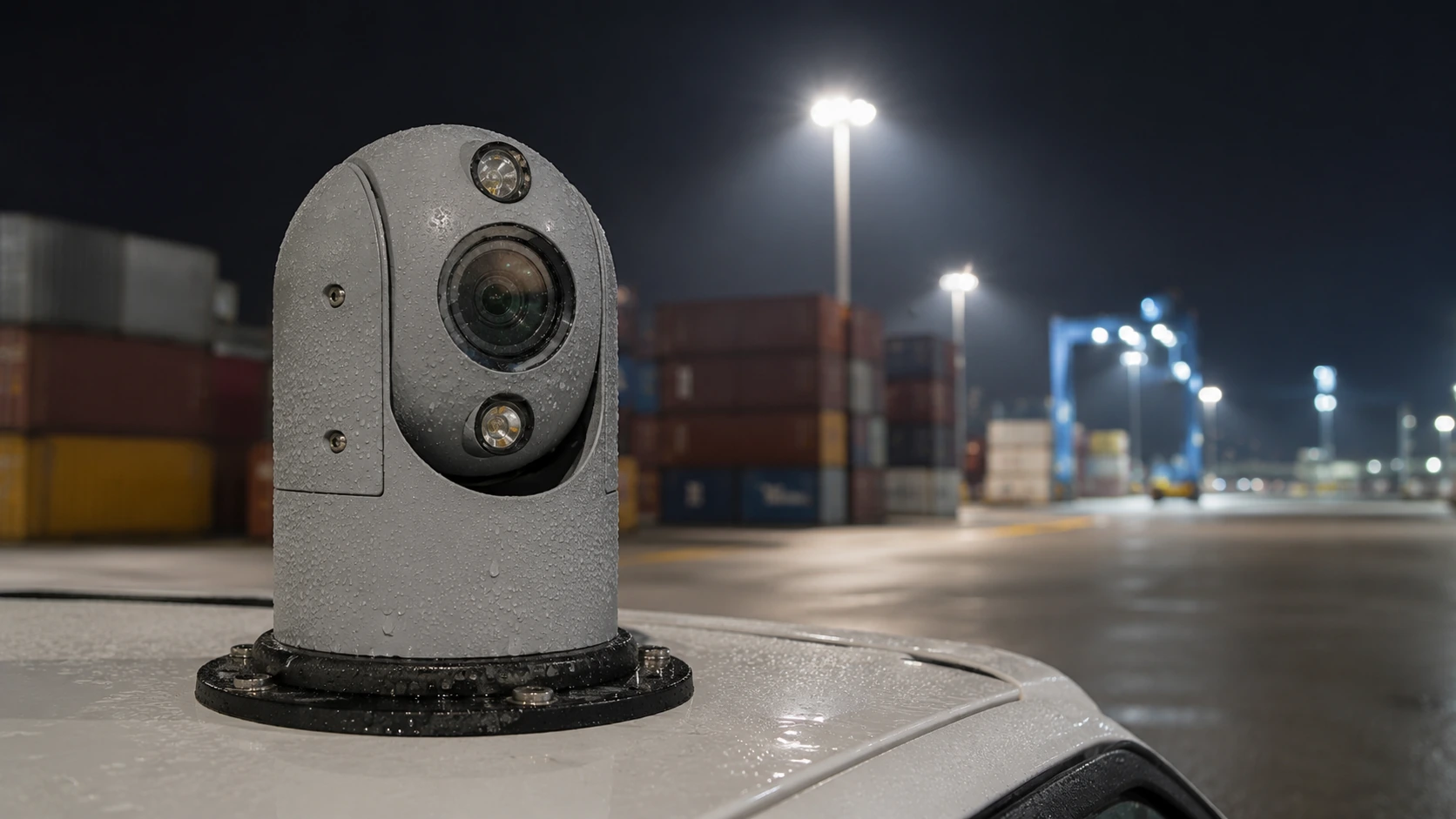
Roof mounted pan tilt zoom camera at night in a container terminal, with stacked containers and quay lighting behind it
QuaysideA steerable camera on a terminal vehicle, working a container stack after dark. The same recorder behind it takes the fixed channels on the machine.
01

Patrol and inspection vehicles

Gate patrol, yard supervision and mobile inspection. Four channels covers a vehicle: road ahead, cabin, rear and one on the working side. A roof PTZ earns its place where a unit has to see past a stack or a cordon.

Channels
Four on a car, from a dash camera or a recorder
Steerable
Roof PTZ where the unit works a gate or a cordon

Border authorities are putting smart inspection cars into service, from early 2026, carrying six cameras for full 360-degree coverage and reading faces at about ten metres. That is the direction an inspection vehicle is travelling in this country.

02

Terminal and airside equipment

Terminal tractors, yard trucks, tugs, loaders and ground support equipment. Recorders in the range take four, eight or twelve channels on one box and accept mixed analogue camera formats, which is what matters on a fleet bought over fifteen years.

Channels
Four, eight or twelve on one box
Rating
Seven of the eight recorders run minus 20 to plus 70 degrees, on 12 or 24 volts

Ground handling audits increasingly ask operators to declare their ground support equipment fleet. Against a ground damage bill of around five billion dollars a year, a recorder on the machine is the cheap part of the argument.

03

Material handling

Forklifts, reach trucks and reach stackers. The same recorders drive the same camera formats here, and the blind spot and driver monitoring options are usually the reason this equipment gets a camera at all.

Driver AI
Blind spot detection and driver monitoring, specified at order
Mounting
Quoted per machine, against the model and the mast height

Mast, carriage and fork mounting is decided per machine, so we quote it against the truck model and the mast height. Send us the fleet list and we will come back with a fitting per machine type.

From the inspection to the case file

Four steps, and the officer is involved in only the first one.

  1. 01

    Dock

    The camera goes into a bay at the end of the shift. It charges and offloads in the same action, and nobody opens a file or renames anything.

    Video Infrastructure
  2. 02

    One server, every gate

    Footage from the hall, the gate and the yard lands on infrastructure the operator owns, in your own rack or in a data centre in your country. Where a port authority, a terminal operator and a handler each run their own, the server boundary is where responsibility for a recording gets drawn.

    Private server
  3. 03

    Evidence management

    Search across officers, shifts, gates and vehicles. Attach clips to an inspection or a claim, set which supervisors see which operator's footage, and let retention run to policy.

    Chain of custody
  4. 04

    Release

    A clip leaves for customs, an insurer or the police as a permissioned action, with an approval record and an audit entry behind it. This is the step an operator gets asked about.

    Evidence platform

On the part of the range that carries a SIM, a control room can watch a gate or a stand while the shift is still running. That side is on Live Streaming.

Questions procurement teams ask

The ones that come up most often when a border, terminal or airport operation is scoping a first deployment.

Do customs officers wear body cameras?

Yes, in a growing number of customs administrations. Officers conducting inspections are monitored with body-worn cameras, alongside the electronic locks and satellite tracking used to follow an inspected export container to the port of exit. Published deployments in this sector are still few. Ports, airports and free zone operators each set their own policy.

All seven sectors

Are body cameras allowed airside at an airport?

Access airside is controlled by the airport operator through the security pass regime, and driving out there needs an airport driving permit. A camera worn by staff sits inside that regime, so the answer comes from the operator's approved aviation security programme and from whoever holds the pass, never from a general rule. Send us the operator and the role and we will tell you who has to sign it off.

Talk to us about a site

Who owns the footage when a terminal operator, a port authority and a handler are all involved?

Whoever issued the camera. That sounds obvious until three organisations are standing at one incident with three retention policies, and one of them is asked to produce a clip six months later. The practical answer is to draw the line at the server: each operator holds what its own officers recorded, every release is logged, and that release record is what settles a later argument about who had what.

Chain of custody

Which body camera suits a customs or port inspection role?

It depends on whether anyone needs to watch live. A customs hall with a dock in it is a strong case for an offline camera with no SIM and no monthly data line. A yard patrol at the far end of a 25 kilometre quay is not. Most orders of any size mix the two, because a gatehouse and a mobile inspection unit do not need the same thing. All nine models are listed with full specifications and a comparison table.

Compare all nine models

How long does footage have to be kept?

Rules rarely set a figure for this sector. Where an enforcement rule applies it usually defers retention to a central security standard, and everyone else sets their own. In practice the number comes from the claim window in the operating contract. It is also the figure that sizes the server, so settle it before you settle resolution.

Storage and retention

What drives the cost of a border or terminal deployment?

Four things, in this order: how many posts are covered at once, whether the cameras carry SIMs, what resolution you record at, and how long you are obliged to keep the footage. The last two multiply together and are what sizes the server. Our cost guide sets out the drivers without quoting prices, because a real figure comes from the post list.

Project Cost Guide

See it running before you specify it

We run the whole chain in front of you: cameras, vehicle recorders, docking, server and evidence management. Bring your post list, the shift pattern and the retention your operations policy sets, and we will put a specification against them.

Body Camera Models

Two ways to deploy. Browse below.

Request a Demonstration

Tell us where the cameras will be deployed and we will arrange a demonstration with the right models for your sector.

Connect on WhatsApp